

By Dr. Melisa Arias-Valenzuela, C. Psych.
If you’ve ever found yourself thinking:
“Why can’t I just stop obsessing about my body?”
“I know these thoughts aren’t helping, but I can’t seem to stop.”
“I feel trapped between restricting, overeating, guilt, and promising myself I’ll do better tomorrow.”
You’re not alone.
Many people assume body image struggles or disordered eating are simply about appearance, food, or willpower. But from a psychological perspective, these behaviours often make much sense when we understand the emotions driving them.
One model I frequently use in therapy is the Three Circle Model from Compassion Focused Therapy (CFT), developed by Professor Paul Gilbert. Rather than asking, “What’s wrong with me?”, this model invites a much more compassionate question:
“What is my nervous system responding to and motivating me to do?”
Understanding these emotional systems can be incredibly freeing and can explain why body image recovery often feels so difficult.
Importantly, research over the past two decades has increasingly supported this compassionate perspective. Notably, research by researchers like Dr. Allison Kelly has been showing that cultivating self-compassion is associated with improvements in body image, eating behaviours, and emotional well-being. Rather than simply feeling “better” about ourselves, compassion appears to change how we respond when body image struggles inevitably arise.
Understanding the Three Circle Model
The Three Circle Model is one of the foundational concepts in Compassion Focused Therapy (CFT). Rather than viewing difficult emotions or behaviours as signs that something is “wrong” with us, the model helps us understand how our brains have evolved to manage life’s challenges.
According to CFT, we all have three emotion regulation systems that work together to help us survive, pursue what matters, and connect with others. Each system serves an important purpose, and none of them are inherently “good” or “bad.” Difficulties arise when these systems become out of balance. For example, when our threat system is constantly activated, our drive system becomes consumed by the pursuit of the “ideal” body, or our soothing system has little opportunity to develop.
For many people struggling with body image or disordered eating, this imbalance can create a cycle of shame, self-criticism, and behaviours that make sense in the short term but keep suffering going over time. Understanding these systems helps us move away from asking, “What’s wrong with me?” and toward a more compassionate question: “What is my nervous system trying to protect me from?”
Let’s take a closer look at each of these emotional systems.
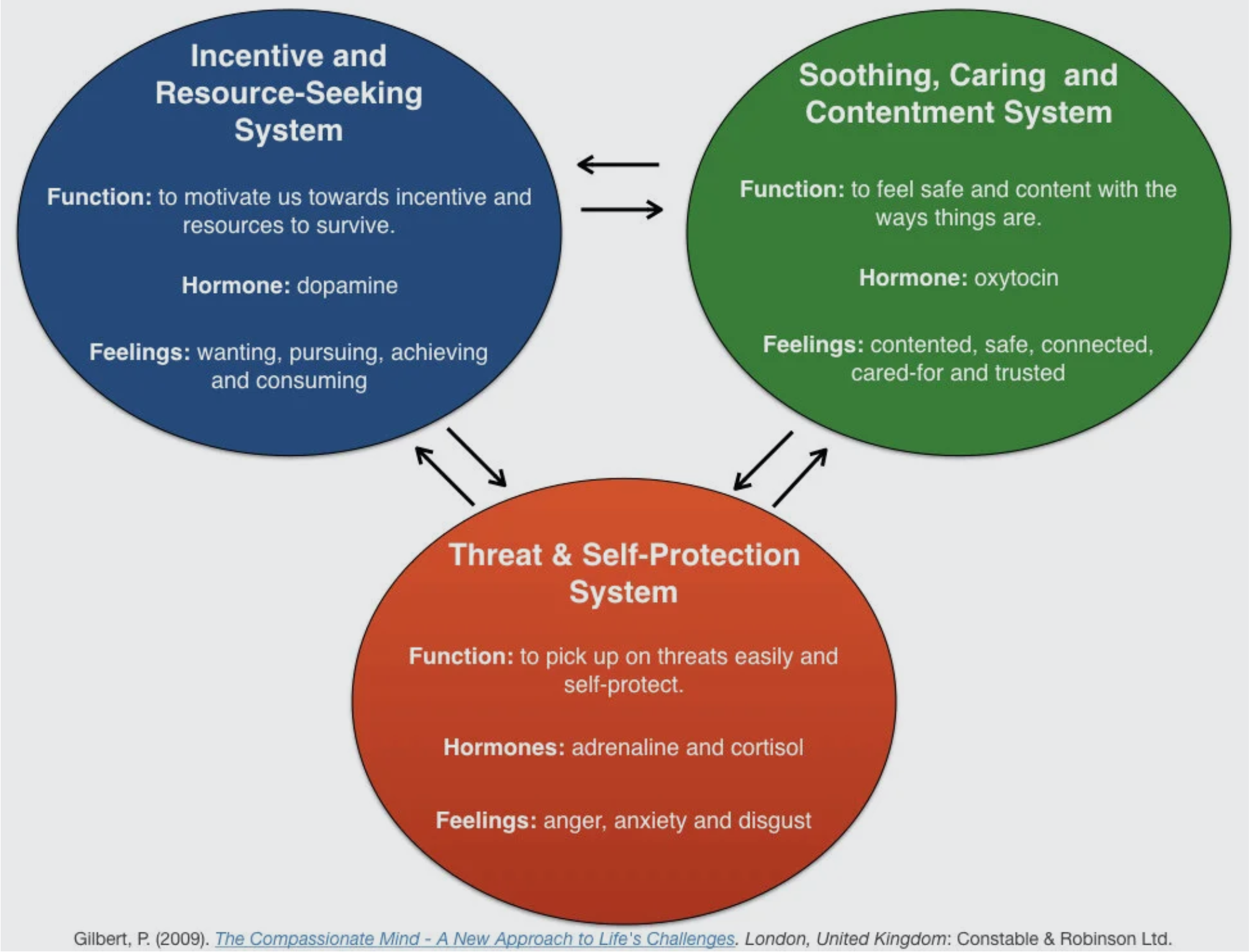
1. The Threat System: “Something Is Wrong With Me.”
The Threat System evolved to keep us alive.
Its job is to detect danger and help us respond quickly.
It activates emotions like:
- Anxiety
- Shame
- Fear
- Disgust
- Anger
In modern life, our brains often perceive social threats just as intensely as physical ones.
For someone struggling with body image, these threats might sound like:
- “People will judge how I look.”
- “If I gain weight, no one will love me.”
- “I don’t belong unless my body changes.”
- “I need to hide.”
This may, in turn, motivate certain types of responses such as:
- Body checking
- Avoiding mirrors
- Restricting food
- Compulsive exercise
- Comparing yourself to others
- Social withdrawal
These behaviours often look irrational from the outside.
From the perspective of the threat system, however, they’re attempts to stay safe.
Research also tells us that shame and self-criticism are not simply by-products of eating disorders, but that they are important processes that help maintain them. When we criticize ourselves for our body or eating, we’re often activating the very emotional system that’s keeping us stuck (aka the threat system).
2. The Drive System: “Maybe If I Achieve Enough…”
The Drive System motivates us to pursue rewards and accomplishments.
It’s what helps us work toward goals, experience motivation, and celebrate success.
In body image struggles, however, this system can become hijacked by the pursuit of the “ideal body.”
Instead of pursuing a meaningful life, the drive system becomes focused on:
- Weight loss
- Calories
- Exercise
- Appearance
- External validation
- Perfection
This creates an exhausting cycle:
“If I just lose a little more weight, then I’ll finally feel confident.”
Unfortunately, relief is usually temporary.
The brain quickly shifts the goalposts.
What once felt “good enough” no longer is.
Many people living with eating disorders describe feeling trapped in this endless pursuit, not because they lack insight, but because their drive system has become fused with the promise of safety and self-worth.
3. The Soothing System: “I Am Safe Enough.”
The Three Circle Model in Disordered Eating
From Self-Criticism to Self-Compassion: Changing How We Respond to Ourselves
Final Thoughts
If your relationship with your body feels like a constant battle, it doesn’t necessarily mean you’re lacking motivation, discipline, or willpower.
It may simply mean your nervous system has been working very hard to protect you.
The Three Circle Model reminds us that healing isn’t about eliminating difficult thoughts or forcing yourself to love your body overnight.
Instead, it’s about gradually creating more balance between the systems that protect us, motivate us, and help us feel safe.
As research has demonstrated, recovery often begins not with dramatic transformations, but with small moments of responding to ourselves differently. A little more warmth. A little less criticism. A little more willingness to stay with discomfort rather than fight it.
Because body image recovery isn’t about never having difficult days.
It’s about having new ways of meeting those days when they come.
Looking for Support with Body Image or Disordered Eating?
Our psychologists provide evidence-based, compassionate therapy for body image concerns, disordered eating, eating disorders, and self-esteem. We draw from approaches such as Compassion Focused Therapy (CFT), Acceptance and Commitment Therapy (ACT), and Cognitive Behavioural Therapy–Enhanced (CBT-E) to help clients build a healthier relationship with food, their body, and themselves.
Book a free 15-minute consultation to learn more about our services and find the therapist who best fits your needs here.
References
Gilbert, P. (2009). The Compassionate Mind. London: Constable & Robinson.
Gilbert, P. (2020). Compassion: From its evolution to a psychotherapy. Frontiers in psychology, 11. doi: 10.3389/fpsyg.2020.586161
Goss, K., & Allan, S. (2014). The development and application of Compassion-Focused Therapy for eating disorders (CFT-E). British Journal of Clinical Psychology, 53(1), 62–77. doi: 10.1111/bjc.12039
Kelly, A. C., & Stephen, E. (2016). A daily diary study of self-compassion, body image, and eating behavior in female college students. Body Image, 17, 152–160. doi: 10.1016/j.bodyim.2016.03.006
Kelly, A. C., Vimalakanthan, K., & Miller, K. E. (2014). Self-compassion moderates the relationship between body mass index and both eating disorder pathology and body image flexibility. Body image, 11(4), 446-453. doi: 10.1016/j.bodyim.2014.07.005
Kelly, A. C., Carter, J. C., & Borairi, S. (2014). Are improvements in shame and self-compassion early in eating disorder treatment associated with better patient outcomes? International Journal of Eating Disorders, 47(1), 54–64. doi: 10.1002/eat.22196
Book Your Free Discovery Call