

By Dr. Melisa Arias-Valenzuela, C. Psych.
You can have friends, a busy schedule, and people who care about you—and still feel lonely. Here’s what psychology tells us about loneliness, why meaningful connection matters for our health, and how therapy can help.
Have you ever felt lonely in a room full of people?
Maybe you have friends and family, but still feel like nobody really understands you. Perhaps you’ve moved to a new city, experienced a breakup, or noticed that friendships have gradually drifted apart.
Or maybe your days are filled with work, family responsibilities, and social interactions, yet something still feels missing.
Loneliness doesn’t always look like being physically alone. It can look like feeling disconnected from the people around us. It can be the quiet feeling that we don’t quite belong, that we’re missing meaningful relationships, or that we don’t have anyone we can truly be ourselves with.
And during certain times of year, such as the holidays, those feelings can become especially noticeable.
Loneliness is a deeply human experience. But when it becomes persistent, it can have important consequences for our mental and physical health.
The good news? Loneliness isn’t necessarily a permanent state, and understanding what’s contributing to it can help us find ways to reconnect.
What Is Loneliness, and Why Do We Experience It?
In psychology, loneliness is generally understood as the distressing experience that occurs when there’s a gap between the social connections we want and the ones we feel we have.
Importantly, loneliness and being alone aren’t the same thing.
- Social isolation refers to having relatively few social relationships or limited social contact.
- Loneliness refers to the subjective experience of feeling disconnected, unsupported, or dissatisfied with our relationships.
You can enjoy solitude without feeling lonely. And you can feel profoundly lonely while surrounded by people.
Research suggests that loneliness may serve an important evolutionary function. Just as hunger signals our need for food, loneliness may signal our need for social connection.
Throughout human evolution, belonging to a group was important for survival. Social connection offered protection, cooperation, and support.
From this perspective, loneliness isn’t evidence that something is wrong with us. It’s a signal that an important human need may not be getting met.
However, just as chronic stress can affect our well-being, persistent loneliness can become distressing and difficult to navigate.
What Does Loneliness Actually Feel Like?
Loneliness doesn’t always show up as sadness. Sometimes, it can be subtle and difficult to recognize.
You might notice:
- Feeling disconnected even when spending time with others.
- Wishing you had someone who truly understood you.
- Feeling left out, forgotten, or unimportant.
- Comparing your friendships or relationships to those of others.
- Hesitating to reach out because you worry about being a burden.
- Feeling anxious about social interactions or fearing rejection.
- Withdrawing from others, even when you crave connection.
- Feeling emotionally exhausted after socializing.
- Experiencing a sense of emptiness or lack of belonging.
For some people, loneliness is connected to major life transitions: moving, becoming a parent, changing jobs, experiencing illness, retiring, or ending a relationship.
For others, loneliness may be related to longstanding patterns of social anxiety, self-criticism, difficulty trusting others, or feeling different from the people around them.
And sometimes, loneliness is shaped by broader circumstances, including discrimination, marginalization, accessibility barriers, or limited opportunities for community connection.
There’s no single reason people experience loneliness, and no single solution that works for everyone.
The Science of Loneliness: Why Connection Matters for Mental and Physical Health
We often think about social connection as something that makes life more enjoyable. But decades of psychological and health research suggest that our relationships are also closely connected to our overall well-being.
Loneliness, Depression, and Anxiety
Persistent loneliness has been associated with increased symptoms of depression, anxiety, and psychological distress.
The relationship can also work in both directions.
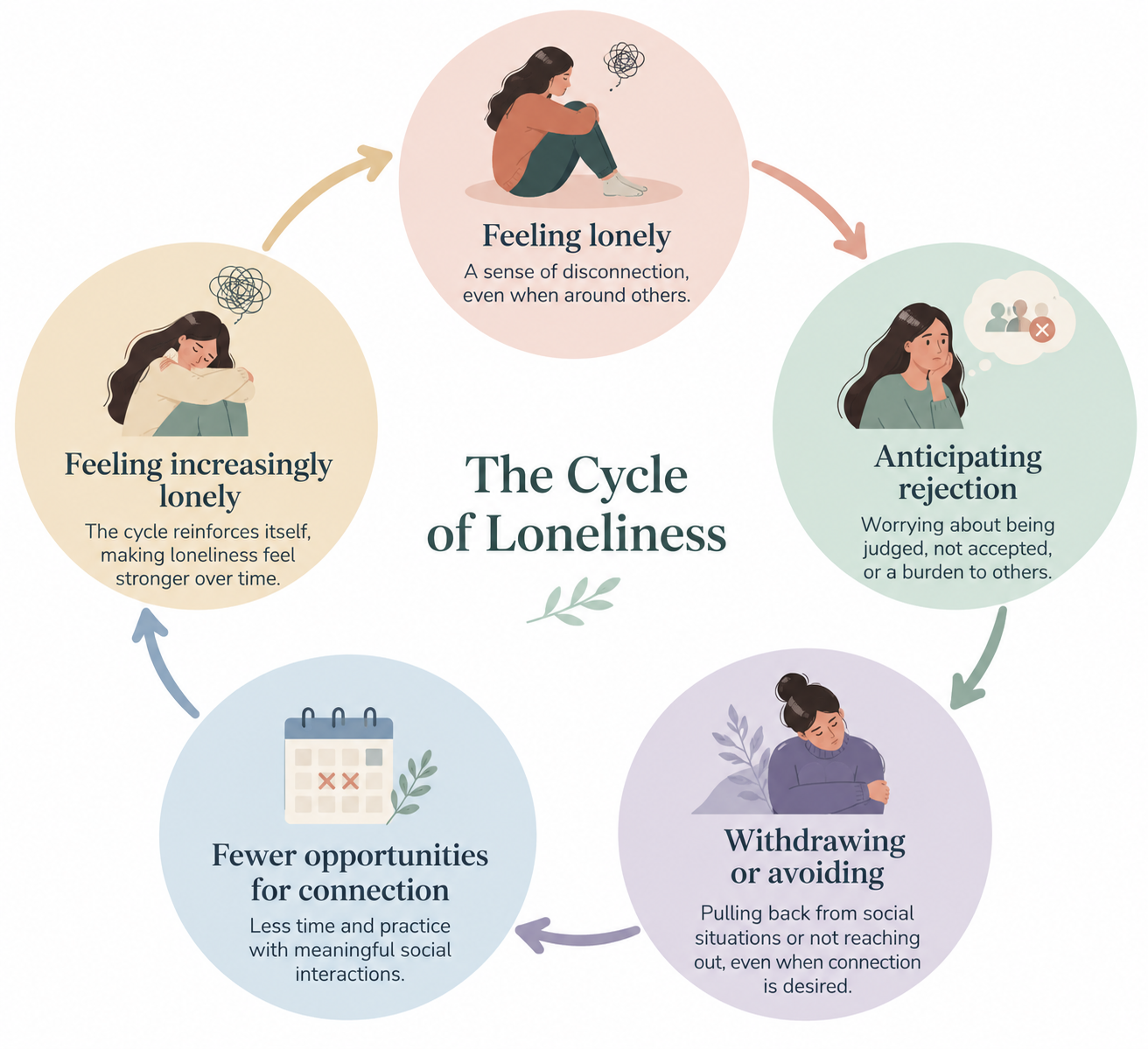
For example, someone experiencing depression might withdraw from social activities because of low energy or motivation. That withdrawal may reduce opportunities for connection, potentially intensifying loneliness.
Similarly, someone experiencing social anxiety might avoid interactions because they fear judgment or rejection. Although avoidance can bring temporary relief, it may also prevent opportunities to build the relationships they want
Over time, these experiences can create a difficult cycle:
Can Loneliness Affect How Long We Live?
One of the most striking findings in the research on loneliness concerns its relationship with physical health and mortality.
In a landmark 2010 meta-analysis, psychologist Julianne Holt-Lunstad and colleagues examined 148 studies involving more than 308,000 participants. They found that people with stronger social relationships had approximately 50% greater odds of survival during the study follow-up periods compared with people with weaker social relationships.
The researchers concluded that social relationships are an important factor in health and longevity, with associations comparable in magnitude to several established health risk factors.
You may have heard the claim that loneliness is as harmful as smoking 15 cigarettes a day.
This comparison has been widely discussed, including in the 2023 U.S. Surgeon General’s advisory on loneliness and social isolation.
The comparison reflects the magnitude of mortality associations observed in population-level research. It does not mean that feeling lonely is biologically equivalent to smoking cigarettes, or that an individual episode of loneliness carries the same health risk.
More recent research supports the broader connection between social disconnection and health.
A 2023 meta-analysis published in Nature Human Behaviour, examining 90 prospective studies and more than 2.2 million participants, found that:
- Social isolation was associated with a 32% higher risk of all-cause mortality.
- Loneliness was associated with a 14% higher risk of all-cause mortality.
Both were associated with increased risks of cancer mortality.
These findings are observational and don’t establish that loneliness directly causes earlier death.
Nevertheless, they demonstrate why social connection deserves attention as an important part of health and well-being.
The takeaway isn’t that we should become worried about every moment of loneliness. It’s that our need for connection is worth taking seriously.
Why Can Loneliness Become a Difficult Cycle?
Here’s something particularly interesting about loneliness: the very experience of feeling disconnected can sometimes make it harder to reconnect.
How Can Therapy Help With Loneliness?
Small Steps Toward Feeling More Connected
While meaningful relationships often take time to develop, there are small steps we can take to create more opportunities for connection.
Consider:
- Prioritizing quality over quantity. A meaningful conversation with one person may feel more fulfilling than several superficial interactions.
- Creating regular opportunities for connection. Joining a recurring class, volunteering, or participating in a community group can allow relationships to develop naturally over time.
- Taking small social risks. Reaching out, initiating plans, or sharing something personal can feel uncomfortable, but may create opportunities for closeness.
- Being curious about your needs. Are you craving companionship, emotional intimacy, shared interests, or a stronger sense of community?
- Practicing self-compassion. Building relationships can be difficult, and not every interaction will lead to connection. That doesn’t mean you’ve failed.
And remember, meaningful connection doesn’t always need to come from traditional friendships or romantic relationships. Community groups, chosen family, neighbours, colleagues, and shared activities can all contribute to a sense of belonging.
When Should You Consider Therapy for Loneliness?
Loneliness is a normal human experience, and occasional feelings of disconnection don’t necessarily require professional support.
However, therapy may be helpful if loneliness is persistent, causes significant distress, or begins affecting your mental health and everyday life.
You might consider reaching out if you notice that you’re increasingly withdrawing from others, struggling with social anxiety, experiencing low mood, feeling chronically disconnected, turning to substances or other unhelpful coping activities to deal with it, or finding it difficult to build or maintain relationships.
Therapy can also be particularly helpful during transitions that change our social worlds, including moving, relationship changes, parenthood, retirement, grief, or significant changes in health.
At Uprise Psychology & Wellness in Ottawa, our clinicians provide compassionate, evidence-informed therapy for individuals navigating loneliness, anxiety, depression, relationship challenges, self-esteem concerns, and major life transitions.
Our approach recognizes that every person’s experience is different. Together, we can explore the factors contributing to your loneliness and identify meaningful, realistic steps toward greater connection.
Thinking about therapy? We offer 15-minute consultation calls to help you ask questions, explore your needs, and determine whether one of our therapists might be a good fit.
Book your FREE 15-minute consultation at Uprise Psychology & Wellness
References
Holt-Lunstad, J., Smith, T. B., & Layton, J. B. (2010). Social relationships and mortality risk: A meta-analytic review. PLOS Medicine, 7(7), e1000316. https://doi.org/10.1371/journal.pmed.1000316
Holt-Lunstad, J., Smith, T. B., Baker, M., Harris, T., & Stephenson, D. (2015). Loneliness and social isolation as risk factors for mortality: A meta-analytic review. Perspectives on Psychological Science, 10(2), 227–237. https://doi.org/10.1177/1745691614568352
Wang, F., et al. (2023). A systematic review and meta-analysis of 90 cohort studies of social isolation, loneliness and mortality. Nature Human Behaviour, 7, 1307–1319. https://doi.org/10.1038/s41562-023-01617-6
Hickin, N., Käll, A., Shafran, R., Sutcliffe, S., Manzotti, G., & Langan, D. (2021). The effectiveness of psychological interventions for loneliness: A systematic review and meta-analysis. Clinical Psychology Review, 88, 102066. https://doi.org/10.1016/j.cpr.2021.102066
Masi, C. M., Chen, H. Y., Hawkley, L. C., & Cacioppo, J. T. (2011). A meta-analysis of interventions to reduce loneliness. Personality and Social Psychology Review, 15(3), 219–266. https://doi.org/10.1177/1088868310377394
Office of the Surgeon General. (2023). Our epidemic of loneliness and isolation: The U.S. Surgeon General’s advisory on the healing effects of social connection and community. U.S. Department of Health and Human Services.
Book Your Free Discovery Call