

By : Amélie Vézina, Ph.D. candidate in Clinical Psychology at uLaval and Doctoral Associate at Uprise Psychology & Wellness
“How many hours of sleep do I need?”
“How can I get exactly 8 hours tonight?”
“How do I fall asleep faster?”
“Why can’t sleep without cannabis?”
These are some of the most Googled questions about sleep—so if you’ve ever wondered about any of them, you’re definitely not alone.
But they all have something in common.
They assume that sleep is something we can directly control.
I have good and bad news for you.
Let’s start with the bad news (ouch!) :
You can’t force yourself to sleep.
Unlike improving your nutrition or physical exercise, sleep isn’t something you can achieve by trying harder. You can’t will yourself to fall asleep, command yourself to stay asleep, or guarantee that you’ll get exactly eight hours every night.
In fact, the harder you try to sleep, the more awake you often become.
Frustrating? Absolutely.
Now for the good news (yay!) :
Although you can’t control sleep itself, you can create the conditions that allow sleep to happen naturally.
Think of it like growing a plant.
You can’t make a seed grow by pulling on its leaves. No amount of effort, worrying, checking on it every five minutes, or wishing it would grow faster will make it happen.
What you can do is provide the right conditions: healthy soil, enough water, sunlight, and time.
Once those conditions are in place, you trust the plant to do what it was designed to do.
Sleep works the same way.
Your brain already knows how to sleep. It has been doing it since before you were born. Most sleep difficulties occur because one or more of the systems that support sleep are being disrupted… and not because your body has forgotten how to sleep (Phew!)
The three ingredients your brain needs for healthy sleep
Think of these as the “soil, water, and sunlight” for sleep.
🌙 1. Sleep drive (homeostatic sleep pressure)
The longer you’re awake, the greater your body’s drive for sleep becomes—much like hunger builds the longer you go without eating.
Napping late in the day, spending too much time in bed, or sleeping in can reduce this sleep drive and make it harder to fall asleep at night.
☀️ 2. Your circadian rhythm (your internal body clock)
Your circadian rhythm determines when your body is biologically ready to be awake and when it’s ready to sleep.
Morning light, regular wake-up times, physical activity, and consistent daily routines help keep this clock synchronized.
⚠️ 3. Stress and arousal
Even if your sleep drive is high and your body clock is perfectly timed, it can still be difficult to sleep if your brain is in “threat mode.”
Stress, anxiety, frustration about not sleeping, excessive monitoring of sleep, and even trying too hard to sleep can keep your nervous system activated.
The goal isn’t to eliminate stress completely, it’s to reduce the unnecessary arousal that gets in sleep’s way.
Once you understand these three systems, many of the most common sleep questions suddenly make much more sense.
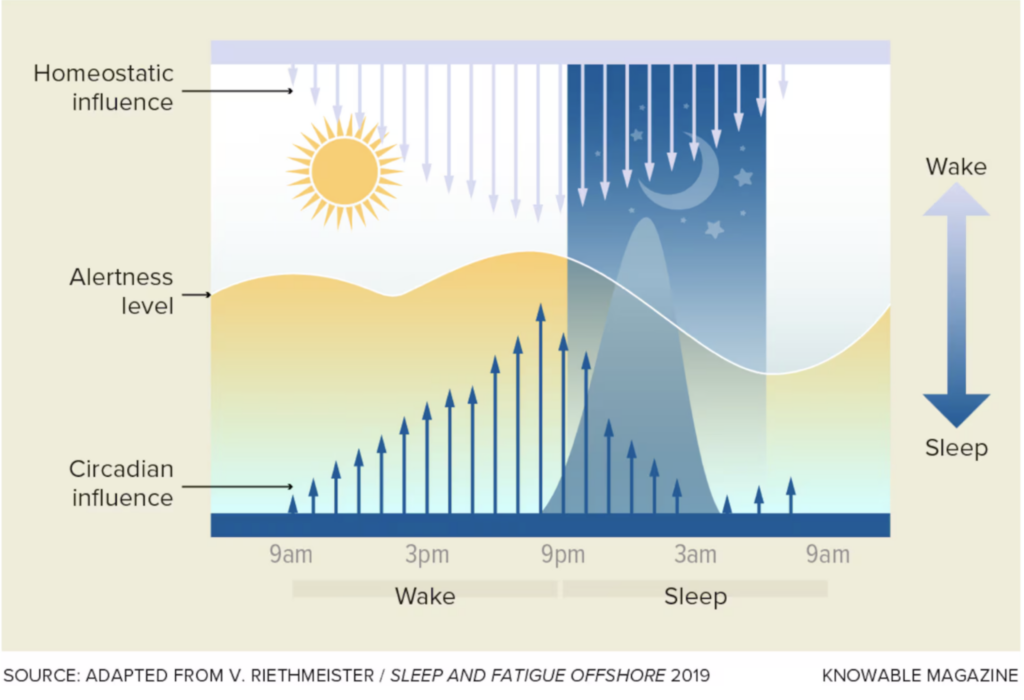
Image retrieved from: https://english.elpais.com/science-tech/2025-02-23/the-ones-who-need-little-sleep.html
“How many hours of sleep do I need?”
Most adults function best between 7 and 9 hours, but there is no magic number that guarantees good health.
Ironically, chasing exactly eight hours often increases stress about sleep, making it harder to achieve.
“How can I make myself fall asleep faster?”
You can’t.
But you can strengthen your sleep drive, support your circadian rhythm, and reduce unnecessary arousal—all of which make sleep much more likely to happen naturally.
“I can’t sleep without cannabis.”
Cannabis can feel helpful for sleep because it may promote relaxation and drowsiness. But its relationship with sleep is more complicated than it seems—and the research is mixed.
A recent systematic review found improvements in self-reported sleep quality with cannabinoids (da Silva et al., 2025). However, a study using objective sleep measures (polysomnography, an overnight sleep test that measures brain activity and other physiological signals while you sleep) found that long-term daily cannabis use was associated with more wakefulness during the night (Velzeboer et al., 2026). One explanation for this discrepancy may be expectancy: people who believed cannabis would improve their sleep tended to think they fell asleep earlier and slept longer than objective measures indicated (Livingston et al., 2026).
The takeaway? Feeling like you slept better doesn’t always mean you objectively slept better. With regular cannabis use, reducing or stopping can temporarily disrupt sleep as part of normal withdrawal. Without support or guidance from a healthcare professional, these changes can understandably feel stressful and frustrating—and may further reinforce the belief that “I can’t sleep without it.” (Health Canada, 2024).
And here’s another important piece: although cannabis may help you feel more relaxed in the short term, it doesn’t directly address the two main biological processes that regulate sleep: building enough sleep drive (or sleep pressure) and keeping your body clock in sync. This may help explain why feeling calmer or sleepy after using cannabis isn’t necessarily the same as improving the underlying processes that support healthy, sustainable sleep.
“Why do I wake up during the night?”
Brief awakenings are completely normal.
Often, it’s not the awakening that’s the problem—it’s the stress that follows: checking the time, worrying about tomorrow, or trying desperately to fall back asleep.
So what is within your control?
You can’t control sleep.
You can influence the three systems that regulate it.
That’s exactly what Cognitive Behavioural Therapy for Insomnia (CBT-I) helps people do.
Rather than teaching people how to force sleep, CBT-I helps them:
- Build healthy sleep drive.
- Synchronize their circadian rhythm.
- Reduce the stress and pressure surrounding sleep.
The result isn’t “perfect sleep.”
It’s allowing your brain to do what it already knows how to do.
Interested in improving your sleep naturally?
This fall, we’re offering a CBT-I group program where you’ll learn practical, evidence-based strategies to work with your body’s natural sleep system—not against it. Learn more about our upcoming CBT-I group here!
About the author

Written by Amélie Vézina, Ph.D. (cand.)
Doctoral Associate at Uprise Psychology & Wellness
P.S. Wondering why I care so much about sleep?
I completed my Ph.D. research in clinical psychology at the Sleep Disorders Laboratory at Université Laval in Québec City, where I spent several years studying insomnia and its treatment.
For my doctoral research, I compared two approaches to treating insomnia in university students: Mindfulness-Based Stress Reduction (MBSR) and Cognitive Behavioural Therapy for Insomnia (CBT-I).
Want to guess which one came out on top for improving insomnia?
Hint, hint… it starts with a C and ends with an I. 😉
More on that and what my research taught me about actually improving sleep in a future blog post.
References
Borbély, A. A., Daan, S., Wirz-Justice, A., & Deboer, T. (2016). The two-process model of sleep regulation: a reappraisal. Journal of Sleep Research, 25(2), 131–143. https://doi.org/10.1111/jsr.12371
da Silva, G. H. S., Barbosa, E. C., de Lima, F. R., Barroso, D. C., Paez, L. E. F. E., Guimarães, F. B. M., Lança, S. B., de Faria, S. B. C., Petrucci, A. B. C., Garbacka, A., & Walsh, J. H. (2025). Effectiveness of cannabinoids on subjective sleep quality in people with and without insomnia or poor sleep: A systematic review and meta-analysis of randomised studies. Sleep Medicine Reviews, 84, 102156. https://doi.org/10.1016/j.smrv.2025.102156
Health Canada. (2024). Health effects of cannabis. Government of Canada. https://www.canada.ca/en/health-canada/services/drugs-medication/cannabis/health-effects/effects.html
Livingston, N. R., De Young, K., Merwin, A., & Looby, A. (2026). Cannabis Expectancies for Sleep Modulate Discrepancies Between Subjective and Objective Sleep Outcomes: A Pilot Study. Journal of Psychoactive Drugs, 1–10. Advance online publication. https://doi.org/10.1080/02791072.2026.2644855
Morin, C. M., Khullar, A., Robillard, R., Desautels, A., Mak, M. S. B., Dang-Vu, T. T., Chow, W., Habert, J., Lessard, S., Alima, L., Ayas, N. T., MacFarlane, J., Kendzerska, T., Lee, E. K., & Carney, C. E. (2024). Delphi consensus recommendations for the management of chronic insomnia in Canada. Sleep Medicine, 124, 598–605. https://doi.org/10.1016/j.sleep.2024.09.038
Velzeboer, R., Wei, S., & Lai, W. W. K. (2026). Chronic cannabis use and sleep architecture: A cross-sectional analysis of polysomnography outcomes in a sleep-clinic cohort. Sleep, 49(5), zsaf396.
Want to Make an Appointment? Book Your Free Discovery Call